









Now that spring is in bloom, winter weather is no longer top of mind. However, salt still persists in our waterways and soil, threatening not only our aquatic ecosystems but also the health of humans and wildlife.
Students recall how it felt to reluctantly return to school on a chilly morning after wishing for a snow day. Salt glistened white and teal on the sidewalks and parking lots of Loudoun County High School. It crunched under students’ feet whose soles carried the residue inside the building, leaving the floor a cloudy mess. We’ve become accustomed to loads of salt on our roads and sidewalks, melting ice to keep us safe; it’s an ordinary part of our winter.
Amanda Hren, the LCPS Environmental Health & Safety Coordinator, and the Assistant Director of Facilities Operations, Brian Schmidt, stated that “the responsibility of our snow removal teams is to allow for the safest, quickest, and most equitable reopening of our school facilities. They are responsible for clearing access routes to prevent slips/trips on campus.” These removal teams also apply salt and sand on school properties.
However, this same compound designed to keep us safe threatens our local ecosystems and even human health.
Salt’s Impact on our Streams
Amy Ulland, the stream monitoring coordinator at Loudoun Wildlife Conservancy, states that the impact of road salt on streams here in the county “[is] more serious than most people realize.” She added, “sites that see high chloride levels in the winter tend to see worse biological scores in spring stream surveys,” indicating that a stream ecosystem is in bad health. For example, macroinvertebrates, small aquatic insects, are bioindicators of stream health and also a source of food for other aquatic species. When these critters die out, it creates a chain reaction that affects all wildlife in the area.
Moreover, Ulland claims that salt pollution is “especially bad in suburban and urban streams, where roads, sidewalks, and parking lots send salt-laden runoff directly into waterways with almost no natural filtering.”
Common Misunderstandings
There is a lot of misunderstanding and uncertainty surrounding road salt pollution. For example, a lot of people assume that water going into storm drains gets treated, the way sewage does. But Ulland says, “It doesn’t. Storm drains flow directly into our local streams, completely untreated. Every extra grain of salt swept into a drain goes straight into the water where fish, insects, and other wildlife live.” Furthermore, this same claim is stated on the Loudoun County Government’s website. “Stormwater runoff is not conveyed to a treatment system and travels directly to local waterways.”
Ulland notes, “bags of pet-safe or eco-friendly ice melt at the hardware store are often not what they claim,” because their labels are not regulated/standardized. “No government agency oversees those terms, which means any company can put them on a bag regardless of what’s actually inside. Some of these products still contain chlorides—just under different chemical names.” For example, ingredients like potassium chloride, calcium chloride, or magnesium chloride are just as harmful as sodium chloride if used excessively.
Best Salting Practices
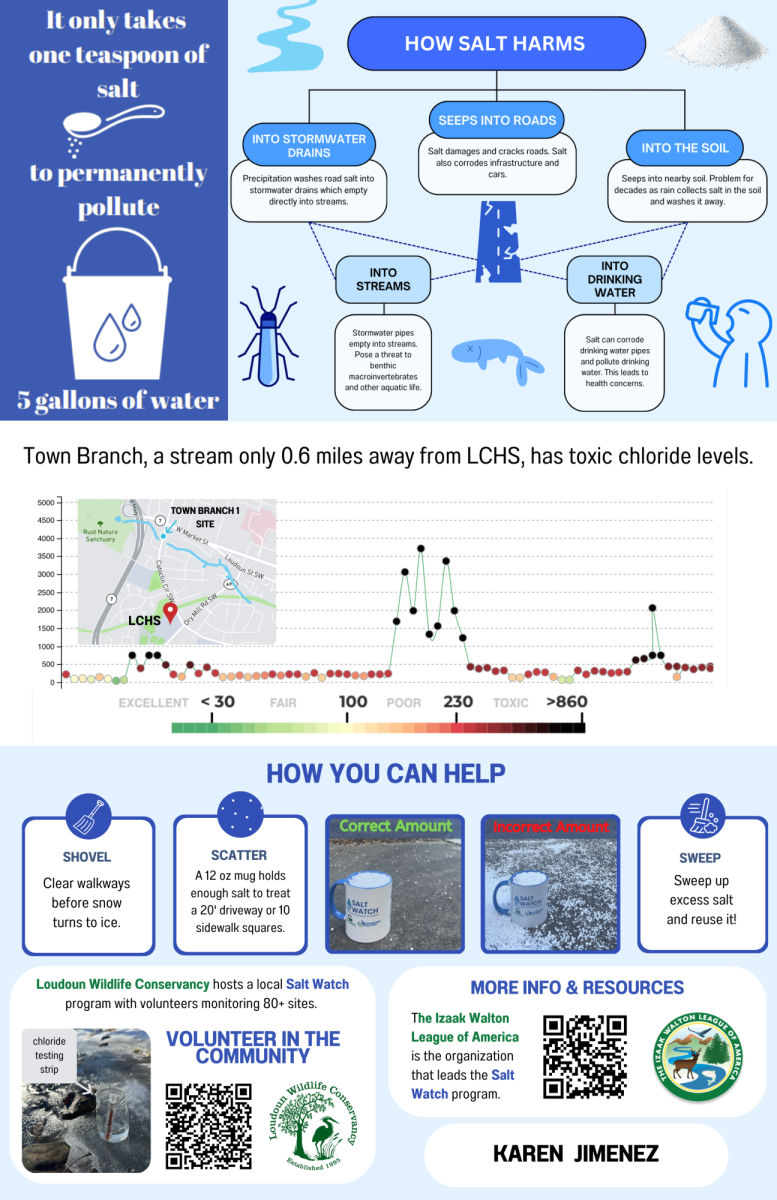
Ulland says, “The good news is that being smarter about salt doesn’t mean being less safe—it just means being more thoughtful.” Using the shovel, scatter, sweep method (as seen in the infographic) is a beneficial way to lessen our impact while still staying safe.
Ulland adds, “For schools, businesses, and local governments, one of the most effective switches is moving to liquid brine for pre-treating surfaces before a storm,” . According to Wisconsin’s Department of Transportation, brine is more effective, uses less material, and saves money. Simultaneously, this method of application leads to less salt, and its harmful consequences, in water bodies. This is the current method of application used by the Virginia Department of Transportation (VDOT), who maintains the major roads in the county.
LCPS: Safety is the Priority
According to Hren and Schmidt, LCPS applies more salt to parking lots if a snow event is predicted to be less than 1 inch then reapplies later to control ice spots. On the other hand, custodial teams shovel sidewalks and apply a sodium or magnesium chloride mixture to ice spots.
Hren and Schmidt also state that decisions to sweep up remaining salt and sand “have to be made against concerns about melting/refreezing of adjacent plowed snow piles.”
When questioned if a school’s proximity to a stream affects its salt application, Hren and Schmidt stated that “relative proximity to surface water bodies does not currently affect salting procedures.”
What can we do as a community?
Ulland discusses the importance of communicating sustainable salting methods at home: “Talk to your family about smarter salting,” she says. “And the next time someone reaches for a bag of deicer, encourage them to flip it over and read the ingredients. These small things genuinely matter.”
There is an opportunity to get directly involved in data collection at local streams: Salt Watch is Loudoun Wildlife Conservancy’s community science program that trains volunteers to test chloride levels in local streams.
Ulland shares, “You could be monitoring a stream right in your own neighborhood—and your data becomes part of the county-wide picture. It was Salt Watch data that helped the Department of Environmental Quality identify road salt as the number one stressor in the Broad Run watershed. That’s the power of community science, and students can be a part of it.”
Small changes, Big difference
Now that spring is in bloom, winter weather is no longer top of mind. However, salt still persists in our waterways and soil, threatening not only our aquatic ecosystems, but also the health of humans and wildlife. Luckily, this problem can be combatted by making small changes to our day-to-day habits. Adopt the salt, scatter, sweep method and tell neighbors about the impact of road salt. We all rely on Loudoun’s waterways. Let’s be sure to protect it for future generations.