
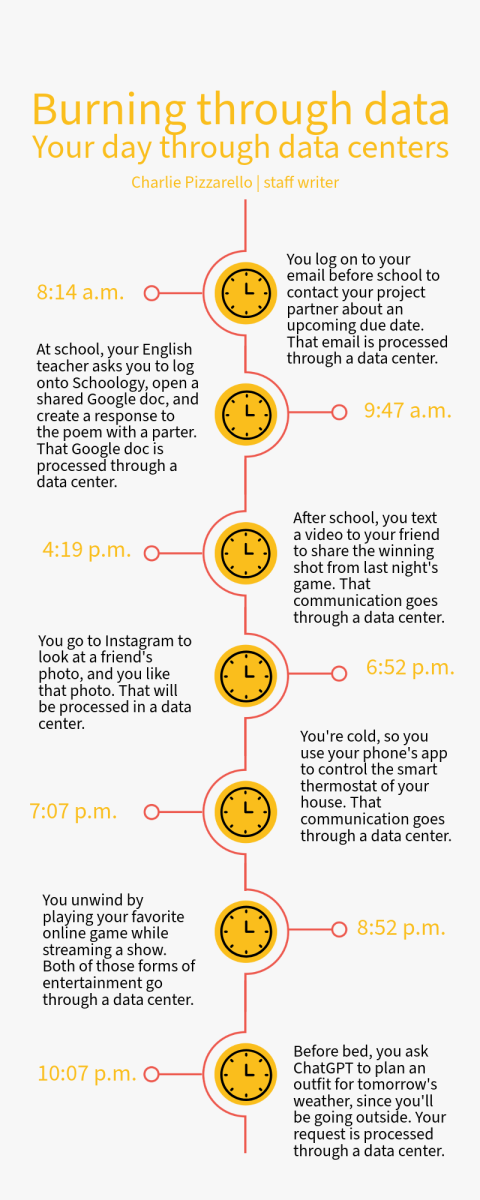














Earlier this year, the staff of The County Chronicle toured two data centers. We were able to learn about the history of data centers in our area, what they are used for, and what the future outlook is for data center expansion.
Our question about why “Data Center Alley” is located in a place with such a high cost of living as Loudoun County was answered when we learned about how the fiber optic cables set decades ago made our area desirable for further data center expansion.
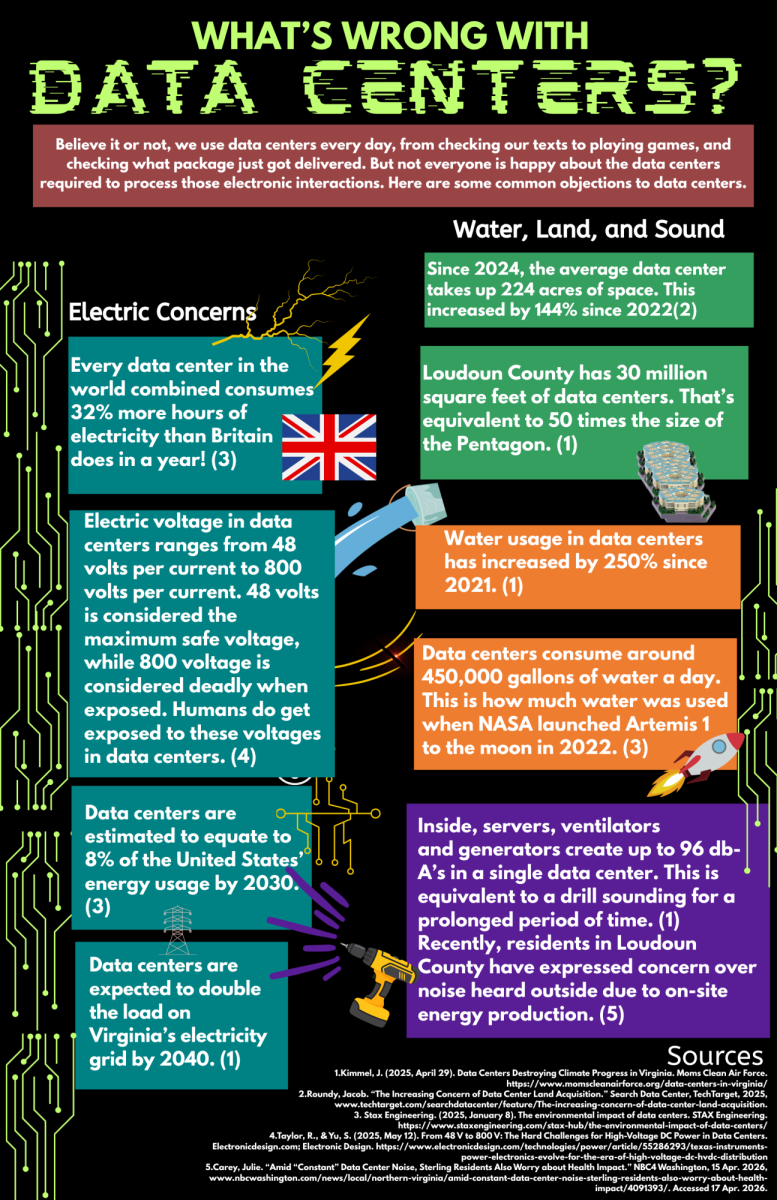
Now, a simple local shopping trip puts us across the street from a data center, and residential complaints keep coming up in the news.
We set out to write about data centers earlier in the year. We thought maybe we could create a one-page spread that concisely summarized data centers for the readers. Are they good? Are they bad? Are we for or against them? We imagined we would come up with an easy answer.
We’ve delayed writing about the issue because honestly, it’s a complex issue without an easy answer. Are they taking up land? Yes. Are they using electricity? Absolutely. Are they extraneous? Not the way we might have thought.
We were surprised by some of the things we saw and learned on our tour. First, they were heavily guarded. We knew that, but when we ended up interacting with the guards at the gate, we realized how much security really goes into a data center. And the reason is startling.
While data centers may house the resources that allow us to have a conversation with ChatGPT, we would survive if our Chat went away. But those same data centers also house and process information for hospitals, financial institutions, and the government.
Our tours made it clear that data centers are not just some fun way to play better video games or get help on an assignment. They are literally a matter of national security.
We were also surprised to learn how few people we actually saw inside a data center. In each data center we toured, we awere escorted by one or two guides, and in the course of our time walking through the facility, we could count on one hand the number of people we saw inside the secure areas.
When it comes to jobs, we learned that only a handful of people work in a data center. There are employees who run security, and then there are technicians who know how to monitor and repair the equipment. In fact, we were surprised to learn that there are sleeping quarters in data centers so that during weather events like blizzards, there are always technicians available to service the equipment. If the servers go down, important hospital, financial, and government data go down with it. Data centers are considered essential to operating 24 hours a day, seven days a week, just like hospitals.
We were also surprised to learn that data centers have contracts with fuel companies to provide fuel within an agreed-upon number of hours (single digits) in the event of an electricity outage. Data centers will take fueling priority over other locations, since it’s so important to keep those servers running. Data centers are equipped with redundant systems that ensure a power outage does not impact them.
Jobs in data centers are few, and most employment comes through contract work. As for job creation, it’s all about construction. Companies that use a lot of data—Amazon unofficially came up a number of times—are unable to build data centers fast enough to meet demand. They often lease space in existing data centers until they are able to build their own, and the race to build data centers is a swift one. Companies seek localities open to the idea but also look for space available and look at how long the wait is for electric companies to be able to supply them with a reliable supply of electricity (the wait is measured in years). Construction workers willing to travel can make big money building one data center and moving on to the next.
As for what we can do to reduce our demand for land-consuming data centers, we as a staff got into some interesting discussions about our use of AI and whether it was overall doing humanity a service or a disservice.
While AI does have some benefits, such as being able to handle certain tasks faster than humans, our overall consensus was that it ultimately fails to truly serve as a helpful tool for those who use it. AI causes us to become increasingly reliant on technology to solve our problems, and its increased use has led to more people in all industries getting replaced by artificial intelligence. When we learned about a professional newspaper using AI to write its stories, we created a podcast discussing AI and its effects on the human race and how we can not lose what it means to be human.
Ultimately, it’s undeniable that both data centers and artificial intelligence will continue to affect us in the future. With evolutions being made to AI and data centers continuing to grow in size, modern technology continues to expand whether we want it to or not. What matters is how our relationship with technology will evolve and change for the better as technology continues to develop. •